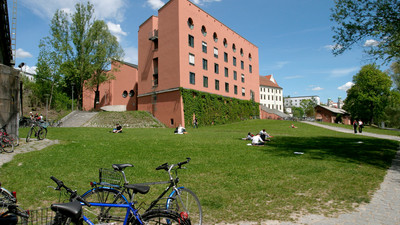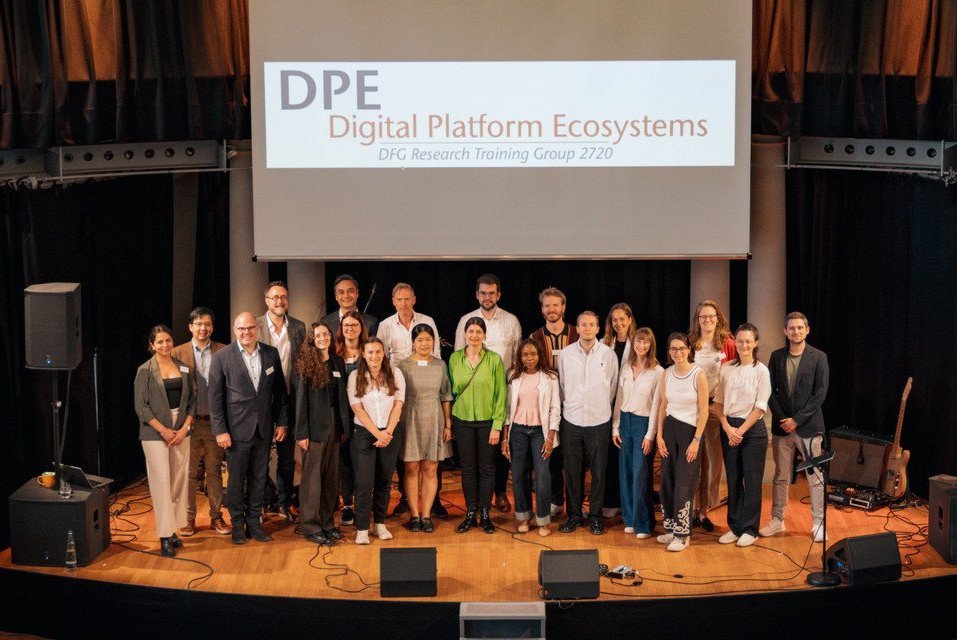
The DPE Forum 2026, which took place on 15 and 16 June at the University of Passau and the Passau Redoute, focused on the development, power and regulation of digital platforms. The conference is the public flagship event of the DFG Research Training Group 2720 “Digital Platform Ecosystems” (DPE).
Since 2022, early-career researchers there have been investigating the development of digital platforms from various disciplines. This year’s theme was: “Critical Perspectives on Digital Platform Ecosystems: Governance, Influence and Consequences.”

From CEOs to sex workers: Anastasiya Shylina, a graduate of the DFG Research Training Group 2720 ‘Digital Platform Ecosystems’, explores in her doctoral thesis who really shapes digital platforms.
An unconventional research approach
Shylina’s doctoral thesis is entitled: “From CEOs to Sex Workers: Digital Platforms, Ecosystems, and the Persons Within”. Her work breaks with the tradition of viewing platforms primarily from a technical or economic perspective. In it, she combines management theory with sociological and psychological perspectives. “I focus on the people behind the platforms,” explains the researcher. “How do their characteristics, prejudices and emotions influence the strategies of platform ecosystems?”
How effective is interoperability between messenger services? Does it really foster competition and innovation? These are some of the questions being examined by a team from the University of Passau, led by Professor Jan Krämer, Chair of Information Systems, as part of a new bidt project.

Obtaining German citizenship by birth lowers crime among adolescents with an immigration background. That’s according to a recent study by the University of Passau (including Prof. Dr. Stefan Bauernschuster) and the ifo Institute and on the reform of citizenship law in 2000.

Professor Carolin Häussler is deputy chair of the Commission of Experts for Research and Innovation (EFI), which has submitted its 2026 annual report to the German federal government. In this video interview, she explains why Germany is not making better use of the potential from its own research and how this can be changed.

Over time, the loss of human expertise caused by AI use can impair the quality of that very AI – in the worst case, insidiously and unnoticed. This is the finding of a new study by researchers from the University of Passau (Prof. Dr. Jin Gerlach) and Arizona State University, which was recently published in the renowned journal Academy of Management Review.

In a new study, economist Katharina Drescher (Chair of Public Economics) from the University of Passau shows that school social work not only has positive educational effects, but also reduces youth crime